
Over many years our clients have received phenomenal returns on Structured Products. New issues have become increasingly technical, and it is important to understand what you are being offered and what it is costing.
The Discovery Capital 200+ and the Momentum Digital Note both close this month. A quick comparison will highlight the similarities, but a deeper look will expose significant
differences.
Here is our comparison*:
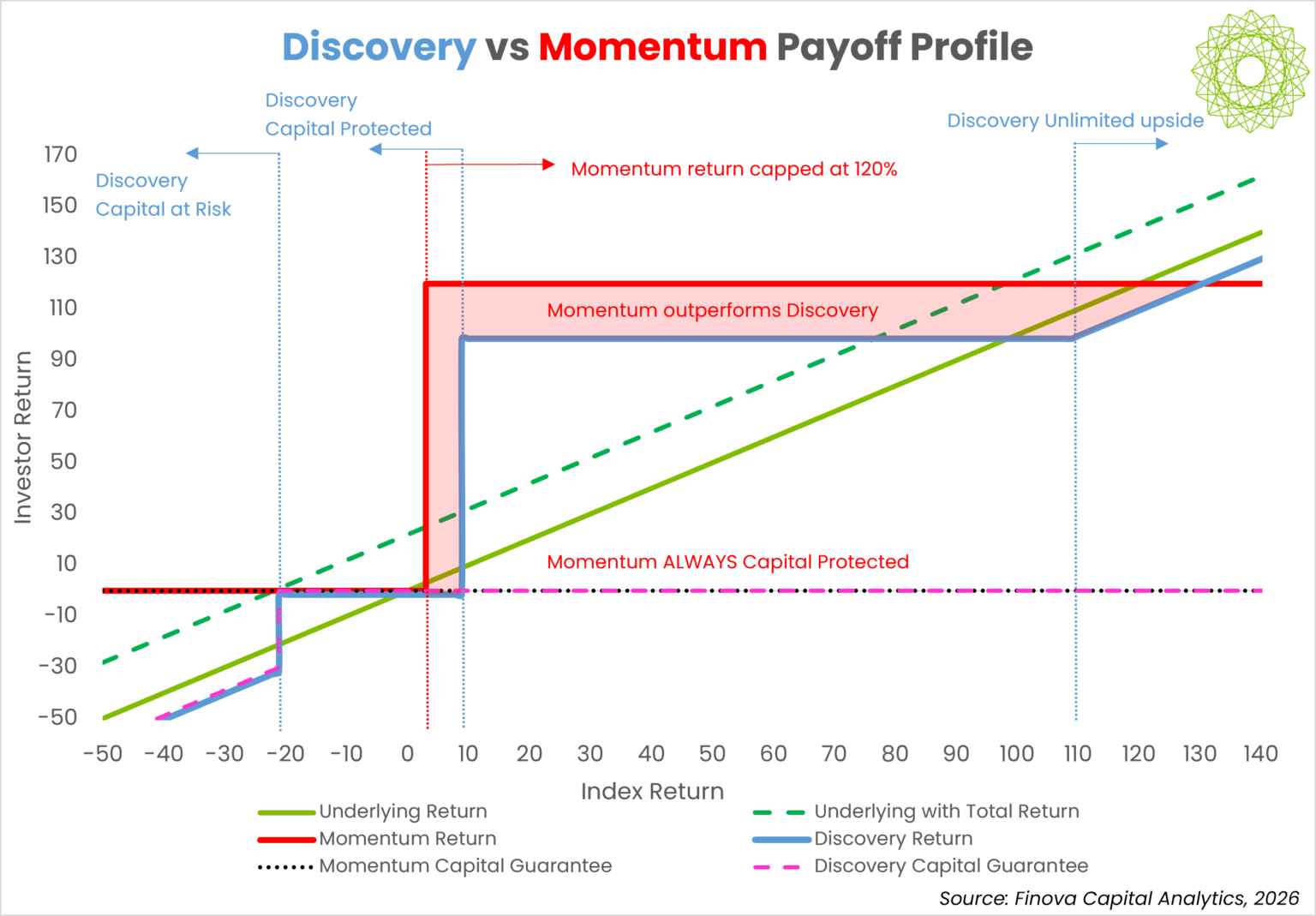
Similarities:
| Discovery Capital 200+ | Momentum Digital Structured Note | |||
|---|---|---|---|---|
| Close | 10 September 2026 | — | 18 September 2026 | — |
| Exposure | Diversified basket of global shares | — | BNP Multi-Asset Diversified X Index | — |
| Capital Protection | Only capital protected if the portfolio doesn’t fall by more than 30% from inital value. | X | 100% capital protection irrespective of index performance. | ✓ |
| Expected Return taxed as CGT |
100% return, with unlimited exposure if portfolio return is > 100% pre-tax, excl. fees |
X | 120% return, if index grows by > 3% over 5 years pre-tax, incl. of fees |
✓ |
| Investment Term | 5 years | — | 5 years | — |
| Finova Rating | 3/5 | X | 4/5 | ✓ |
| Finova Comment | Capital at risk possibility HIGH! | X | VERY HIGH probability of 120% returns! |
✓ |
Differences:
|
|
||||||||||||||||||||
|---|---|---|---|---|---|---|---|---|---|---|---|---|---|---|---|---|---|---|---|---|
In conclusion:
- The Momentum Digital Note is clearly a superior offering, with a Capital Guarantee at 100% it provides significantly better protection and more upside with a lower hurdle.
- The Discovery 200+ Protection falls away in the event of a 30% drawback, however when adjusted for their management fee, that reduces to 21.1%. And considering that the Dividend Yield on that basket is 4.1% which is 22% over 5 years, frankly you aren’t getting any protection at all. The upside is lower and adjusting for fees only kicks in if the basket is up 8.9% at maturity. Clients should avoid this product and consider alternatives.
*we are aware that the underlying indexes are different, but are shown on the same axis for illustrative purposes.